Showing posts with label cinema. Show all posts

Saturday, December 29, 2007

I Am Legend: the world without us. A review

Photobucket

The project of a supersize adaptation of Richard Mathesons sci-fi novel (1954) has been one of Hollywoods hot potato games for the past ten years. Ridley Scott, among others, juggled and struggled with a version tailor made for Schwarzeneggers 12 pack. Bringing the film to life was no mean feat, especially considering the seminal quality of the book it is based on, in the field of modern horror fiction. Matheson widely considered to be the spiritual father of Romeros zombies (the filmmaker himself confessed deriving his inspiration from the novelist). Two adaptations were made, at a time when the threat of nuclear warfare haunted (creative and collective) imaginations: The Last Man On Earth, an odd American-Italian co-production by Sydney Salkow and Ubaldo Ragona (1964) with Vincent Price, and The Omega Man by Boris Sagal (1972), a half-forgotten flawed (and a tad outdated at that) gem that pitted Charlton Heston against a sect-ish group of hooded zombies, emphasized the sacrificial dimension of a man who managed to redeem what little remained of humankind: the hero became a new messiah.

Francis Lawrence, who signed a few music videos for Justin Timberlake and was the man behind the helm of Constantine (an aesthetic success, if not exactly a great movie), inherited the duty of directing the post-apocalyptic Robinson Crusoe castaway tale by Matheson.

The film is a blast on several grounds, but mostly stands out of the recent surge of sprinter-zombie flick fare by the straightforward but modest manner in which it puts the tight and slightly depressive storyline of the book on new tracks, far from standard action-movie pacing and storytelling. It manages to maintain for quite a while (considering it is after mainstream Hollywood stuff) a first-degree, fervent manner of wandering around the possibilities that the narrative opens up, lingering over the dry beauty, with patience and without forcing the , and developing an almost ideal (yes, too bad) dosage of effects.

The plot might seem paper-thin, and can hold in a couple of sentences, but works fine:

A mutated virus designed to cure cancer has gone wrong and decimated the human species. The 10% left alive have been infected with a form of ultra-hardcore rage and transformed into feral, nocturnal creatures that are not unlike vampires, and could actually pass off easily as clones of Klaus Kinski’s Nosferatu. A few (1% of humanity), were miraculously immune against the man-made disease but fell prey to the bald, cannibalistic, infected group. One man, Robert Neville, a military scientist, still entertains the fantasy of finding the cure and “fixing it. In the ruins of a megapolis (originally L.A., here: New York of course, I’ll come back to it), apparently the last survivor of the worldwide biochemical disaster, roams the deserted streets and avenues during the daytime, while the horde of mutants lurk in the lower, darker depths of the Big Apple, away from the sunlight. As night falls, the uglies come out and spread all over the city, forcing Neville to hide in his comfy barricaded Washington Square pad until the flesh-eating loonies get tired of howling at the moon.

What Lawrences film does best is setting a context, as the melancholy camera hovers over the desolation in long, amorphous tracking shots of New York, freeze-framed by the catastrophe. The return of nature and wild life through the cracks of the concrete bestows an almost pastoral, meditative character to the hour-long mise en place of the survivor’s day-to-day existence. The foremost achievement of I Am Legend may be in the lengths to which it expands/extends the post-doomsday chronicle of the lonely times of Robert Neville as a middle-aged idler, one of the main charms of the book. Unhurriedly, the film takes pains to construct a life of loafing around the narrow edge of reason and crack-up, but ordered like clockwork around a set of fixed habits, against the bleak broken down backdrop of the devastated cityscape: Neville pumps gas at an abandoned (of course) station, loots a Tribeca apartment for canned fish, runs some more errands, goes deer-hunting and back home, where he chain-watches dvds and recordings of the Today Show, the futile reminders/remains of an obliterated civilization. Will Smith turns out to be quite the ideal last man on earth, against all odds. Brainy (he’s a virologist after all), brawny (he works out), and musical (he listens to Bob Marley on his iPod), he provides a rock-solid emotional anchor for the viewer and could have carried the whole film on his shoulders, had he been given the chance.

One the most beautiful ideas of the film relies on a minimum of effects : to retain a sense of humanity and social connection, Will Smith talks to mannequins that he has arranged in a mockery of a typical urban life routine, as stand-in shoppers and clerks in a dvd store, where he borrows items every morning. Never had the actor appeared so isolated, devastated, worried, obsessive, desperate, etc. while pulling off the part of the nicest (and only) guy around.

This logic of restraint, patiently established in this magnificent, much talked-about opening, craftily paves the way for the moments of pure, delirious frenzy that drill holes in the vegetative framework: the few overheated (and somewhat underestimated) sequences of confrontation with the enraged ghouls, are impressive displays of digital, hyperkinetic brutality, in the wake of the revisionist trend that Snyders Dawn of the Dead and Boyles 28 Days Later initiated.
In the midst of this CGI fest, Lawrence has nevertheless shot an outstanding but sober in-the-dark scene reminiscent of the videogame Silent Hill (the most formally successful action sequence of the film).

Photobucket

The mushy sentimentality of the flashbacks that punctuate the narrative pales in comparison and constitute the most problematic part of the film: we catch brief glimpses of the chaotic evacuation of New York and terrified exodus that takes place, following the quarantine of the city. But these are less occasions of showing the magnitude of the disaster than familiarizing it (and neutralizing it) as a family drama by showing the protagonist with his wife and kids, in typical Hollywood fashion and establishing the emotional link with the nice little doggy, Samantha (always nice to have a good German shepherd around when you’re the last man on earth).

The film unfolds according to a logic of restraint, fully circumvallated by fear, and the very treatment of the massive zombie attacks, in the mode of pure sideration, underscores the contemporaneity of the tale with today's age of terror/terrorism. The post-9/11 dimension the film is constantly referred to (the devastated site of New York is baptized ground zero by Neville himself), not to mention the post-traumatic, guilt-ridden psychological profile of the character, which speaks volume about the clean break it makes with the 1970s formula - the hero as savior, and so on and so forth. Some might object to the ample rewriting of Mathesons original material, most notably the conclusion, but on the larger scale of the history of the genre, I Am Legend writes itself as a landmark that should not be neglected.

Sphere: Related Content

Monday, December 3, 2007

The Omega Man: last man on earth, the Charlton Heston version

Photo Sharing and Video Hosting at Photobucket


With the new adaptation of Richard Matheson’s 1954 novel, I Am Legend coming up amidst the surge of post-apocalyptic narratives popping up here and there (vampires, zombies, and other creatures of the night and bite), perhaps in reaction/conjunction with growing anxiety about the future in general, and the sudden “World War III” rhetorical escalation in particular, my attention was caught by a similarly-themed film, The Omega Man (1971), by Boris Sagal. As it turned out, it happened to be an earlier cinematographic version of the book (preceded by The Last Man on Earth, with Vincent Price in the lead role in 1964).

Robert Neville roams the deserted, rubble-strewn streets of Los Angeles, the only survivor of a world war that has wiped out mankind. Neville, who has survived the nuclear and biological devastation, injected himself with an experimental vaccine. As the phrase goes, “the last man on earth is not alone”: a few people who call themselves “The Family” have been spared by the engineered plague, but have mutated into a nocturnal, regressive black-hooded lot, afflicted with a quasi-vampiric sensitivity to light, albinism, and homicidal tendencies. Neville fights a desperate, lonely war against the Family, from the safety and exile of his fortress-island of art and science, the derisory remains of a dead civilization. A dated, flawed film (Rosalind Cash's afro, the bad make-up job(s), the soundtrack, etc.) with an interesting edge (Charlton Heston).

Photo Sharing and Video Hosting at Photobucket

Sphere: Related Content

Sunday, December 2, 2007

Epitaph: brief notes

Last month, at Columbia University, the Weatherhead East Asian Institute (WEAI) and the Center for Korean Studies organized a one-day interdisciplinary colloque dedicated to Korean pop culture and its impact/influence in East Asia and in the rest of the world, judiciously entitled “Korean Waves [note the plural],” featuring some of the most respected and prestigious names of academic research on contemporary Korean culture and cinema: Richard Pena, Darcy Paquet, Charles Armstrong, Nancy Abelmann, Kyu-hyun Kim, Kyung Hyun Kim, Wondam Paik, TV-host-turned-graduate-student Park Jungsook, and others.
Supported by the Korea Foundation and the Korea Trade-Investment Promotion Agency, the symposium opened on Friday, November 16th, with the premiere screening of the horrow film Epitaph (Gidam), in presence of the directors, Bum-Shik Jung and Sik Jeong, who introduced their first work, arguably the most remarkable film of a somewhat dull year (for an industry that prosperred for so long both locally and in the rest of Asia). A masterpiece that brilliantly connects beauty and horror, history and psychology.


Photo Sharing and Video Hosting at Photobucket

Sphere: Related Content

Sunday, November 4, 2007

Sex with the enemy: 'Lust, Caution'


Born in Shanghai in 1920, writer/novelist/screenwriter, Eileen Chang (張愛玲, The Rice Sprout Song, Red Rose and White Rose) died in Los Angeles in 1995. She was nicknamed by a few critics the Chinese Jane Austen (ah, the demon of comparison, but coincidentally, Ang Lee did adapt Sense and Sensibility for the screen). Many of her works described everyday life in Shanghai and Hong Kong under the Japanese rule, while scrutinizing the problematic relations between men and women, her short story Lust, Caution (Si jie) provides the literary inspiration for this brilliant and brutal erotic thriller, the first film that Ang Lee has made in China (since Crouching Tiger, Hidden Dragon).

Photo Sharing and Video Hosting at Photobucket

Expectations (including mine) were certainly high for Ang Lee’s new film (which was awarded a Golden Lion in Venice, despite dividing viewers and reviewers) especially after the massive popular and critical success of the gay cowboy drama Brokeback Mountain. With its predecessor, Lust, Caution shares some of the thematic elements, most notably the forbidden love relation. This is where the similarity ends, though. If Ang Lee seems to deal with the same matters here, at least superficially, he does so in a sensibly different manner, and with a more freeform (some would say, loose) cinematic fabric than his previous film.

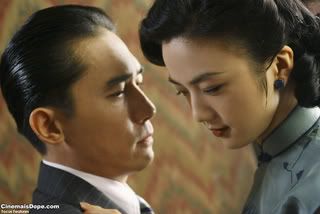
In many ways, the superb opening sequence defines and predetermines the rules and nature of the game that serves as a metaphor for the film as a whole, writing the fate of the main characters in advance, and single-handedly making the film worth a watch: a metaleptic moment during which four chipao-swathed ladies swiftly handle tiles in what appears to be a very intense mahjong game (yet, not a bead of sweat is dropped), while their expressions give out volumes of mute tension, beyond the banter and the bustle of their adroit hands expertly dealing and slapping down the pieces. It soon appears that the youngest of the players, Mak Tai-Tai (Tang Wei) is involved with Yee (Tony Leung), whose wife (Joan Chen) regulaly hosts the social/mental games. On the most banal level, this sequence reveals a beneath-the-surface type of hinter-drama, stoically hidden behind a casual bourgeois décor. More importantly, like all games, the incipit casts the roles of the losers and the winners, a world of shifting identities where something, someone will lose something, him/herself, somehow or other. It is then revelead, in the following scene (a noir-ish French café sequence), that Mrs. Mak, supposedly a rich and bored businesman’s wife, really is Wong Chia-Chi, a young university student turned actress/seductress that might have already long lost her cool, and abandoned her cause in the arms of a villain, as the past flashes back into focus, making it clearer how she came to this.

From then on, Lust, Caution offers a poignant and passionate spectacle that slowly stages the passage à l'acte (in both the sexual and the criminal sense of the expression) by which the loss (of identity, control, caution, etc.), necessarily devastating, will take place and strip the characters from everything, but suffers a bit from the syndrome of over-stretching (the sex starts one hour and a half into the film). A little like in Hou Hsia-Hsien’s Good Men Good Women, (just a little bit) Lust, Caution gives the viewer a glimpse of the lives and times of a small group of students who like the stage and their country (or the idea of it), and get naively infatuated with the idea of killing Mr. Yee (Tony Leung Chiu-Wai), a high-level official and traitor during the Japanese occupation of Shanghai, from 1937 to 1942, at the onset of World War II, before closing up on the dangerous liaison of the spy and the opaque Yee, which is really what Lee seems to be interested in, first and foremost. The narrative proceeds to follow the young (and not so bright) idealists as they decide to take the leap from theatrical representation to political action. Lead by nationalist enthusiast Kuang Yu-Min (a somewhat bland Wang Lee-Hom, famous Chinese pop star), the group amateurishly organizes the murder of the local collaborator, who’s in charge of interrogating (and torturing) his rebellious compatriots. Acting in the name of an ill-defined greater good first, the troupe finds itself back on track a few years later, after the first phase fizzles out and a man gets lamentably and clumsily stabbed by the terrorist wannabees. This time, they come under the stricter supervision of an older resistance leader. Again, in the name of the cause, Chia-Chi accepts to assume the part of the lethal weapon, worldly Tai-Tai: innocence, illusions, and lives will be lost.

To bring down the bodyguard-surrounded Yee, Chia-Chi has to play the role of the sophisticated married woman to win his trust (like a con artist), his heart (like a courtesan) and insinuate herself into his inner ring. One thing leading to another, the young woman winds up surrendering to the game of seduction and letting herself be seduced by her “victim”, and perhaps by the game itself as she succumbs to the passion of playing and being played, which leads her (them?) astray and afar, further and further from her comfort zone, into the dark territories where desire and death lurk at every corner.

Ang Lee’s mastery of the twists and turns of a tortuous narrative is impressive. The most fascinating aspect of the film is the certainly the way he captures auras and intangible atmospheres, the lying eyes and the unspoken truths, as costumes (and masks?) eventually come off and the flesh gives way to an ecstasy that wreaks havoc on the moral certainties of the unlikely couple. The filmmaker relies more on the skin-deep ambiences than dialogues (mostly in Mandarin, with snippets of Shanghaiese) to convey meaning. The result of this is a handful of very compelling sequences, particularly the erotic scenes, in which Lee captures the sense of a relationship based on an intricate mixture of fear and desire.

As in Brokeback Mountain, the main achievement of the film lies in the outstanding performance of the cast, beautifully enhanced by Rodrigo Prieto’s (who is working with Lee for the second time) dark and cold cinematography. Beyond all formal aesthetic considerations, it is truly the the two leads, Tony Leung Chiu Wai and Tang Wei, who breathe life into the film and bestow its true dramatic dimension, and therefore, value on a narrative that wouldn’t transcend the conventions of the wartime spy drama plot otherwise. Leung, who has built a career on showing an incredible range of deadpan-but-hurt-deep-inside faces, from Andrew Lau’s crime thriller masterpiece, Infernal Affairs, to Wong Kar-Wai’s In the Mood for Love and 2046, offers here a first-rate performance as he explores, through the taciturn character, a broad spectrum of emotions. Alternatively surly and sour, always sinister, and sometimes suddenly flaring up, Leung gives an excellent countrapuntal réplique to the spectacular newcomer Tang Wei, who shines through the film.

Photo Sharing and Video Hosting at Photobucket

Despite the heavy historical dimension of the narrative, the filmmakers hardly lingers over the context and skips most of the ideological and espionage small talk (reduced to the ponderous and midly prepostorous “China will not fail” that set off the intrigue), leaving it as a mere backdrop or pre-text, to really get down to the business of characterization. At 136 minutes, the film is mostly structured around the psychological joust that sketches out between the lovers, who discover and uncover each other in a spinning arena of mixed emotions and contradictory feelings. It takes some time for the pieces of the puzzle to come together and the impatient viewer might find this very lengthy and laborious in the end.
Despite what some viewers and critics have seen as problem of pace, Lust, Caution is still a fascinating piece that makes a consummate shows of the fatal strategies that are set up along the way, in parallel to the march of history. Progressively and painstakingly, the process of sexual seduction develops into the locus and sole engine of pure emotion. In fact, James Schamus and Hui-Ling Wang’s scenario takes meticulous and perhaps excessive care not to rush anything, building up the emotions into a surprising apex: the quasi-rape of the ingénue, who nevertheless gives in to the ruthless and sadistic thrusts of Mr. Yee, with careless abandon in the heat/paroxysm of the moment.

The thriller aspect of the narrative, once the characters lose themselves to each other, become ancillary and should probably have effaced itself from the screen to leave more space for these thrills (even though they come aplenty). Indeed, the film truly finds its raison d’être in the sexual duality of the two protagonists, one that admits no third parties (or loyalties for that matter)
In Brokeback Mountain, the love story took center stage and the sex was almost peripheral. Here, things work the other way around. Sex, raw, real (visibly unsimulated), and shot in the most carnal manner possible, accounts for the psychological undoing of the characters. It constructs the labyrinthic tale of a steamy/stormy liaison in/by which the couple fucks each other (and themselves) to their doom.
Nothing short of fascinating in this respect, Lee’s Lust, Caution is a film that adeptly blends the sexual and the sublime, favoring the personal at the expense of the historical. Strangely, the conclusion seems to say, feelings are not enough to sustain the blend... and Mr. Yee’s eyes let a few helpless tears bleed and concur. Love’s labour’s lost, said somebody.


Photo Sharing and Video Hosting at Photobucket


Technical info:
Production Company: Mr. Yee Productions LLC
Executive Producer: Song Dai, Ren Zhong Lun, Darren Shaw
Producer: Bill Kong, Ang Lee, James Schamus
Screenplay: Wang Hui Ling, James Schamus, based on a short story by Eileen Chang
Cinematographer: Rodrigo Prieto
Editor: Tim Squyres
Production Designer: Pan Lai
Sound: Philip Stockton, Eugene Gearty
Music: Alexandre Desplat
Principal Cast: Tony Leung Chiu Wai, Tang Wei, Joan Chen, Wang Leehom

Sphere: Related Content

Saturday, November 3, 2007

Brief notes on Nanking

Photo Sharing and Video Hosting at Photobucket


Directed by Bill Guttentag & Dan Sturman

Saw it yesterday night.
Bleak catalogue of war atrocities.
Dramatized, dead voices played by high-profile celebrities: Mariel Hemingway, Edward James Olmos, Michelle Krusiec, mingled with the testimonies of the survivors.
Re-enactment of the tragedy.
Manifest desire to make the event, unique, irreversible, non-repeatable.
And yet, echoes everywhere: the Holocaust, the Armenians, Darfur, and so on...
The same, yet always different: human horror.

Sphere: Related Content

Sunday, September 9, 2007

The Bourne Ultimatum: a review

Directed by Paul Greengrass. Produced by Patrick Crowley, Frank Marshall, Paul L. Sandberg & Doug Liman. Written by Tony Gilroy, Scott Z. Burns, George Nolfi, Tom Stoppard (uncredited). Music by John Powell. Cinematography: Oliver Wood. Editing by Christopher Rouse


Photo Sharing and Video Hosting at Photobucket


The Bourne Ultimatum brings to a (perhaps provisional) closure a film trilogy that is, all things considered, way superior to the popular fiction churned out by Robert Ludlum, on which Bourne #3 is loosely based. Jason Bourne, the amnesiac operative hunted down by a variety of ruthless hitmen sent after him by the secret services (an obscure cell of the CIA, that is inferred to be his former employer), is going to find out his origin. A series of relatively conventional events/incidents structures the film and makes it flow forward, while taking it to a more and more abstract dimension. In this abstraction lies the real value of this third episode.
Predator and prey, the protagonist of The Bourne Ultimatum, played by Matt Damon, is a character that makes his way at full speed towards the total conscience of an autonomy acquired in the violence of his (re-)actions and the bare instinct of survival. It is also the ecstatic affirmation of an individual self-determination, a personal autonomy that is perfectly capable of defying and defeating modern systems of tracking, fluidly escaping the multiple eyes of omnipresent cameras.
From Moscow to New York, traveling through London and Tangier, the narrative and it eponymous protagonist progress in a world without frontiers, a realm of simultaneity and ubiquity. The vertiginous feeling of being locked in a global enclosure dominates the film, made up of three long and exciting chases sequences de (an outstanding stakeout sequence in Waterloo Station, London, in which Bourne acts as an embedded remote-control metteur-en-scène, a street-and-roof chase in Tangiers, an ultimate car chase showdown in New York).

Photo Sharing and Video Hosting at Photobucket


Paranoid

During the peaks of the film, Bourne must achieve the impossible : stay hidden at the heart of a world of absolute transparency and visibility, in the midst of a gigantic panopticon, a network system built with the means of modern technology (satellite surveillance, computers, cell phones, microchips).
This third episode of Bourne’s adventures in the realm of international espionage is the one that probably pushes the sensation of paranoia the farthest. It gives the sense of a reality entirely under control/surveillance. That new possibilities offered by modern instrumentation makes the conventions of cinematographic action obsolete is a challenge that the film takes up lives up to, in a splendid manner.
The aesthetic parti pris adopted by Paul Greengrass, which increases the credibility and verisimilitude of the events that unfold on the screen, beyond all likelihood, is a peculiar one. The much talked-about hand-held camera work undermines the stability (certainty) of the regard, is shaky, making impossible for the viewer to find, in this confusion, an undeniable center/focus for the unfolding of the action. What could be considered a simple gimmick, or a stylistic preciosity is here a potent addition to the intensity of the suspense and forms a core element of an ultra-kinetic definition of cinema.

Sphere: Related Content

Saturday, January 13, 2007

I Just Didn't Do It

Photobucket - Video and Image Hosting

Seto Asaka and Suo Masayuki at the Japan Society on Wednesday, January 9th
for the premiere of I Just Didn't Do it


The remains of this film: not so much the intricacies and (of course) absurdities of the Japanese legal system, kafkaesque (do I need to add?), as the cold, distant (haughty?) beauty of the actress, radiant beyond the severity of the lawyer uniform.

Sphere: Related Content

Sunday, October 15, 2006

The Science of Sleep

Went to see the latest Michel Gondry film last night with E ... Was supposed to see The Departed, which was sold out.

I liked this Science of Sleep a lot, for both objective (if there is such a thing) and personal reasons. Deep resonances with the sentimental surrealism of the ensemble

Was quite a throwback to the days when I seeing N., or non-seeing, in a way. Was an odd relationship. Also reminds me of K., now married, with kids. Seems like a lifetime ago.

Photobucket - Video and Image Hosting


Sphere: Related Content