Showing posts with label essay. Show all posts

Monday, January 8, 2007

Reviewing, Revenir, Reverie

Photobucket - Video and Image Hosting

While listening to Hwang Byung-Ki's music


A few words about reviewing. The English word suggests that the activity should be done in retrospect, with the benefit of hindsight.

Looking back like Orpheus or Lot’s wife, over the shoulder, the reviewer returns to a cultural experience, and sees... what exactly? a more general picture perhaps, if s/he sees anything at all. What is seen then is the outline, the contours of the object or the event. Does it mean the re-view is the best picture, the most revealing one? Maybe by then, the object is too far. Maybe, but isn't the first sight too close for comfort? The re-view is essentially the luxury of a farther look, which tries to bridge a gap and bring some kind and sense of proximity with a stranger, a foreigner to a particular experience.

A review is a tiny piece of personal mindscape that wishes to be seen, read, and understood as an account of another's experience. It covertly wishes to become part of the publication process as well and be, in the best of cases, a valuable, aesthetic experience of its own, however secondary.

A review is second-hand intimacy, because the thinking is second hand. In a way, it always comes too late, and in the form of a rough familiarity with an experience that is given second thoughts and value. The evaluative aspect of the review is merciless underlined by the French "critique", which refers to both the perpetrator and his/her (mal)practice.The present reviewer has to admit he probably inherited those critical traits and in particular the roughness of the flippant judge. Wasn’t Paris the shepherd, after all, the first reviewer? He nonetheless hopes his off-handed attempts at practicing writing via writings will be taken in the same lightness of spirit as they were written.

Sphere: Related Content

A draft of the history of manga

As most people probably know, since the recent worldwide spread of the genre, the word manga designates Japanese comic books, originally meant for the domestic readership. They are usually published in the form of series, in black and white - most of the time. Each episode is either a stand-alone, self-contained sequence, or is marked by a progression in the storyline(s). Compared with comic books from other countries, one of the main differences seems to be in the commercial scale and therefore, the financial weight of this specific market. Many manga series sell one million copies each week, while in the West for example, a comic book usually reaches this figure in a year. A manga can be as long as 50, sometimes 70 volumes, called Tankōbon (単行本), each of which being a hundred-odd pages. Readers may have a considerable influence on the length of a series and the stories themselves.

Mass produced, manga are first published as 20-40 page episodes in “anthology” magazines printed on very low-cost newsprint paper. In this phone-book format, they constitute, to a large extent, disposable commodities. They can usually be read in a few hours, the time of a commute ride to work, or school. Once read (and maybe forgotten), it is not rare to leave one’s copy on the seat for the next train passenger to consume and enjoy. There are manga magazines at practically every corner of the street in Japan – in konbini (convenience stores), department stores, specialized kissatten (coffee shops), and of course in bookstores that generally devote them a whole floor (as is the case in the Kinokuniya bookstore in Shinjuku). There is also an abundance of works related to manga, such as drawing and illustration books, and special editions of best-selling series. These premium versions, printed on high-quality paper and known as aizōban (愛蔵版: literally, “favorite edition”) are on the other end of the commercial production. Hard-covered and in larger formats, they are sold as valuable items, rather than ready-to-read pulp.In Japan, comic books do not necessarily follow a cultural trend. Rather, they can generate or be the “mainstream” and inspire other realms of creative and artistic production, from anime, commercials, cinema to philosophy (Azuma Hiroki), design and art (Murakami Takashi). Creating manga has been an important stage in many artists' careers. This was the case of Miyazaki Hayao who became a highly respected author of animation films, to mention a particularly exemplary success. The imagery of manga has also been a rising influence on Western filmmaking, marketing and art.

The word manga first came into use in the 19th century, during the Tokugawa (or Edo) era (1603-1867, when woodblock print artist Hokusai (1760-1849) coined the compound-word by associating the kanji (Chinese character) 漫, man, which means “loose”, “random” or “vulgar” and 画, ga, which means “picture”, or “brush-stroke” to describe the type of characters he had developed for his long-running 15-volume sketchbook Hokusai manga (北斎漫画) published between 1814 and 1878. Woodblock-sequence storytelling had been a respected artistic practice in Japan for two century already. These stories were initially conceived for the educated samurai elite, and represented an exclusive form of art. But later on, during the 18th century, the Japanese “middle-class” (bourgeois and merchants known in Japanese as 町人, chōnin, which means “townspeople”) grew in political power and wealth, thus gaining access to these stories whose circulation was hitherto circumscribed to the upper class. Quite fond of the genre indeed, the merchants’ new affluence made the stories a popular variety of entertainment, in the strongest sense of the word. These woodblocks arranged in sequences were not entirely unlike modern-day manga and constitute a clearly identifiable precursor.

After the Meiji Restoration, which was also, and more fundamentally, a revolution, Japan opened the doors of its culture to foreign influences, which came to change and shape the technology and lifestyle profoundly and in many ways, irremediably. From that moment on, manga generated a newfound interest as they started incorporating Western style of drawing to the usual aspects of the genre, undoubtedly laying the foundations of the comic books we know.

Tezuka Osamu (手塚治虫) can be credited, as it were, for the single-handed creation of the manga as we know them in 1947. His work was to start a whole new and perennial visual pop culture. Before Tezuka started publishing his stories, reading manga was essentially a pre-college activity, and therefore considered a category of entertainment mainly intended for adolescents and children. But the artist elaborated a more dynamic style of illustration, and explored different angles and frames to structure his stories, taking his cue from cinematic techniques he had seen in German and French films of the time. Comic books were basically a two-dimensioned narrative space, similar to a theatrical stage where actors appear laterally from both sides of the wings. The publication of Tezuka’s second but first published series, Shin Takarajima (New Treasure Island), was a turning point in the history of manga, or rather, it announced its first steps of its own history. The scenario of the New Treasure Island, based on Robert Louis Stevenson’s eponymous novel, fascinated the readers at the time – some of whom had long stopped reading comic books. It is no exaggeration to say the manga phenomenon started from this particular story. Since then, it has not ceased expanding and diversifying.The manga project is an attempt at presenting the portraits of manga artists who, in addition to their fame in Japan and other places, have innovated, inspired, challenged the conventions and gone beyond the frontiers of the genre they create in.

Sphere: Related Content

Wednesday, July 26, 2006

Manga: Sanctuary

Photo Sharing and Video Hosting at Photobucket


Art: Ikegami Ryoichi
Story: Fumimura Sho

A political epic about two ambitious young men determined to change the fate of the Japanese nation.This atypical crime-meets-politics thriller was serialized in Big Comic Superior from 1990 to 1995, then released into 12 volumes by Shogakukan. It was collected into nine volumes and published in America by Viz Graphics from 1995 to 1997. Sanctuary was a best-selling title in Japan, and it inspired a live action film. It is also one of the books that has paved the marketplace for adult manga (seinen) in the United States. It was published in France by Kabuto.

Hojo Akira and Asami Chiaki are two men with a master plan. They intend to change the world they live in and the way things have been going. No less. They have chosen two different but parallel paths. One walks in the shadows as a yakuza oyabun (a mafia don), the other in the bright lights of politics. As they rise to the top of Japanese society, where they aspire to find and found a “sanctuary” of their own, they have to face ruthless enemies and formidable factions. Alliances are formed, wars are declared, in both the underworld and the Parliament (called the Diet). Why they want to literally reform the country remains as obscure as their common past in Southeast Asia in the early stages of the story. Progressively revealed, the mystery shrouding their origins adds extra layers of meaning and psychological depth to the characters, whose dimensions take on tragic proportions and are underscored by the realism of Ikegami’s art.
The grand scale of Hojo and Asami’s ambition is clearly shown by the developments of the plot. The pair creates an expanding geography of power: from inside Japan (from the Kanto region to remote areas like Okinawa) to foreign lands like Hong Kong, Russia, and the US, forming, in the process, networks of (virile) loyalty that conquers and converts diverse opponents: brutal mob enforcer Tokai, or mastermind Ibuki, to name a few.
Constructed mostly around Hojo and Asami, the story is distributed into a few subplots involving other yakuzas and politicians, all equally tough (strangely, cops stay in the background and never assume critical importance in the narrative). Those minor, or rather supporting characters, usually appear as powerful antagonists belonging to the old order, but have either hit a dead end or found themselves at a turning point in their lives. After being defeated, countered, or simply convinced, they join forces with Hojo and Asamis side, who represent a new order founded on youth and strength rather than tradition and hierarchy.
Far from a manichean good-vs-evil conflict, the war waged by the two young men brings into questions the legitimacy of the power that be, not power itself. One of the reasons why they are after supremacy, is that they see it is as a sacred space, a sanctuary precisely, not as a factor of tyranny per se. That established politicians and yakuza dons are corrupted by this power is not relevant here. Hojo and Asami challenge them because they abuse their authority to subject “the people” into apathy, and turn them into puppets, drifting from (what they think of as) their original purpose: governing for the sake of the sovereign good, which has no moral implications here.

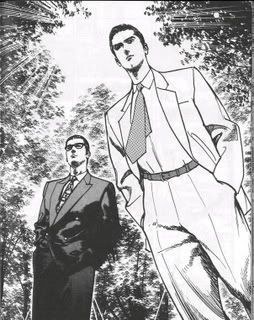
In Sanctuary, Ikegami and Fumimura (also and better known as Buronson) draw a fascinating portrait of a very ambiguous Japan, sometimes dangerously close to reality, where the stakes are breathtakingly high, the design grand, and the characters impossibly charismatic and heroic. Ikegami's art lyrically emphasizes their grandeur with cinematic techniques like low-angle shot look-alike graphics (cf. illustrations above) and creates an intense sense of “cool”. This mise-en-scène is a subtle exploration of the extreme rigidity of a complex hierarchical system based on conservatism, and the relationships of the country with the outside world.

The only flaw of the manga is the many ways in which it projects an unrepentant machismo. While it cleverly shows the intricacies and seductions of power, it is also an uncritical glorification of masculinity, enshrined in a dynamic if slightly hieratic form of realism. Compared with men, women are pretty lightweight, and excluded from the scene of power. Throughout the story, they seem to be reduced to the parts of attendants, sexual for the most part (and mostly provide their “services” to hard-as-nails side-kick Tokai).
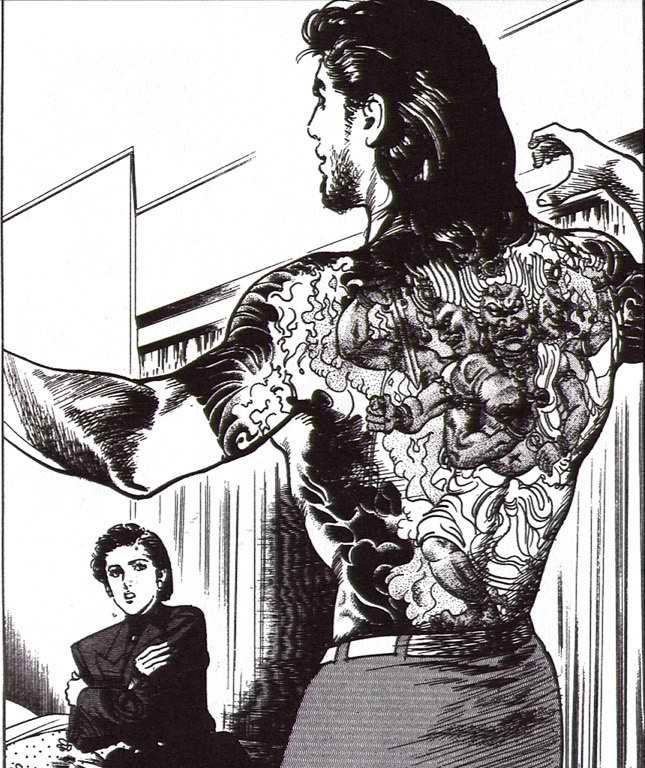
Photo Sharing and Video Hosting at Photobucket


Really, how many times does Kyoko, Hojo’s love interest, have to be naked, taking a shower, a bath, or about to be raped (sexual assault is infinitely possible and always imminent in the manga) ? Sigh. That’s where Sanctuary finds its limits, especially when compared with the similar title, Heat, graced by the presence of strong female characters. Having said this, in the context of Japanese politics and yakuza mobsters, women don’t really have a conspicuous role either. From this perspective, the manga can be viewed as somehow faithful to reality. At any rate, as the story rolls along, this never seems to be a major detraction.

This manga is unquestionably a masterpiece, one of the best graphic novels this reviewer has ever read (and reread many times). It ranks easily as one of the most enthralling stories in any category.

Sphere: Related Content