He knew it was not allowed.
But God. She smelt like heaven.
There was no denying it.

Wednesday, March 21, 2007
Discreet apocalypse: H.


Friday, February 16, 2007
Distance/Analogy
The power of geometric data: perhaps it was installed in transversal signs.
Irreversible, it was blue and the result of temporary retinal inputs.
Thursday, February 8, 2007
Discreet apocalypse: the kayagum player
So she was there. Playing, poised. The demonstration was brilliant, as he knew it would be.
She looked at him, unblinking, smiling an unambiguous polite smile.
They had a very polite talk. Then she asked: "Would you mind if I..."
She wrote down the address of her hotel, a few blocks away from there.
Saturday, January 13, 2007
I Just Didn't Do It

Seto Asaka and Suo Masayuki at the Japan Society on Wednesday, January 9th
for the premiere of I Just Didn't Do it
The remains of this film: not so much the intricacies and (of course) absurdities of the Japanese legal system, kafkaesque (do I need to add?), as the cold, distant (haughty?) beauty of the actress, radiant beyond the severity of the lawyer uniform.
Monday, January 8, 2007
Discreet apocalypse: Issey Miyake
Her name was Heather. He had noticed the name on the tag the very minute he had laid his eyes on her, while she was standing behind the counter and other sales clerks were fluttering around.
She looked severe and professional to an extreme degree. Then she smiled. She was tall and stunning, with very pretty eyes behind austere glasses. Her accent was distinctly Korean, with a tinge of something else, haughty, vaguely snobbish in a subtle and not unattractive manner.
She asked for his name, and where he lived, quite casually. And she smiled some more.
Reviewing, Revenir, Reverie
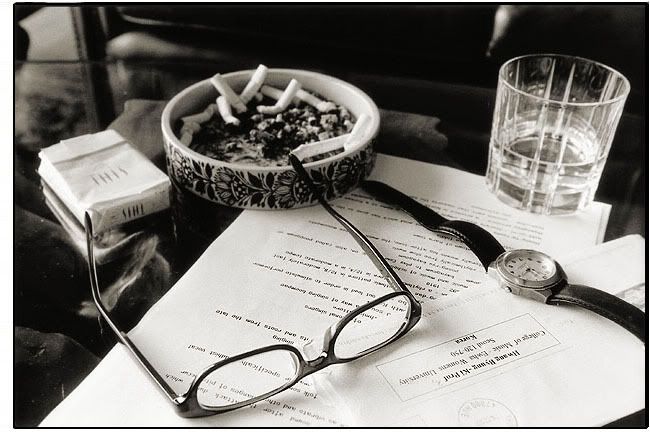
While listening to Hwang Byung-Ki's music
A few words about reviewing. The English word suggests that the activity should be done in retrospect, with the benefit of hindsight.
Looking back like Orpheus or Lot’s wife, over the shoulder, the reviewer returns to a cultural experience, and sees... what exactly? a more general picture perhaps, if s/he sees anything at all. What is seen then is the outline, the contours of the object or the event. Does it mean the re-view is the best picture, the most revealing one? Maybe by then, the object is too far. Maybe, but isn't the first sight too close for comfort? The re-view is essentially the luxury of a farther look, which tries to bridge a gap and bring some kind and sense of proximity with a stranger, a foreigner to a particular experience.
A review is a tiny piece of personal mindscape that wishes to be seen, read, and understood as an account of another's experience. It covertly wishes to become part of the publication process as well and be, in the best of cases, a valuable, aesthetic experience of its own, however secondary.
A review is second-hand intimacy, because the thinking is second hand. In a way, it always comes too late, and in the form of a rough familiarity with an experience that is given second thoughts and value. The evaluative aspect of the review is merciless underlined by the French "critique", which refers to both the perpetrator and his/her (mal)practice.The present reviewer has to admit he probably inherited those critical traits and in particular the roughness of the flippant judge. Wasn’t Paris the shepherd, after all, the first reviewer? He nonetheless hopes his off-handed attempts at practicing writing via writings will be taken in the same lightness of spirit as they were written.
A draft of the history of manga
As most people probably know, since the recent worldwide spread of the genre, the word manga designates Japanese comic books, originally meant for the domestic readership. They are usually published in the form of series, in black and white - most of the time. Each episode is either a stand-alone, self-contained sequence, or is marked by a progression in the storyline(s). Compared with comic books from other countries, one of the main differences seems to be in the commercial scale and therefore, the financial weight of this specific market. Many manga series sell one million copies each week, while in the West for example, a comic book usually reaches this figure in a year. A manga can be as long as 50, sometimes 70 volumes, called Tankōbon (単行本), each of which being a hundred-odd pages. Readers may have a considerable influence on the length of a series and the stories themselves.
Mass produced, manga are first published as 20-40 page episodes in “anthology” magazines printed on very low-cost newsprint paper. In this phone-book format, they constitute, to a large extent, disposable commodities. They can usually be read in a few hours, the time of a commute ride to work, or school. Once read (and maybe forgotten), it is not rare to leave one’s copy on the seat for the next train passenger to consume and enjoy. There are manga magazines at practically every corner of the street in Japan – in konbini (convenience stores), department stores, specialized kissatten (coffee shops), and of course in bookstores that generally devote them a whole floor (as is the case in the Kinokuniya bookstore in Shinjuku). There is also an abundance of works related to manga, such as drawing and illustration books, and special editions of best-selling series. These premium versions, printed on high-quality paper and known as aizōban (愛蔵版: literally, “favorite edition”) are on the other end of the commercial production. Hard-covered and in larger formats, they are sold as valuable items, rather than ready-to-read pulp.In Japan, comic books do not necessarily follow a cultural trend. Rather, they can generate or be the “mainstream” and inspire other realms of creative and artistic production, from anime, commercials, cinema to philosophy (Azuma Hiroki), design and art (Murakami Takashi). Creating manga has been an important stage in many artists' careers. This was the case of Miyazaki Hayao who became a highly respected author of animation films, to mention a particularly exemplary success. The imagery of manga has also been a rising influence on Western filmmaking, marketing and art.
The word manga first came into use in the 19th century, during the Tokugawa (or Edo) era (1603-1867, when woodblock print artist Hokusai (1760-1849) coined the compound-word by associating the kanji (Chinese character) 漫, man, which means “loose”, “random” or “vulgar” and 画, ga, which means “picture”, or “brush-stroke” to describe the type of characters he had developed for his long-running 15-volume sketchbook Hokusai manga (北斎漫画) published between 1814 and 1878. Woodblock-sequence storytelling had been a respected artistic practice in Japan for two century already. These stories were initially conceived for the educated samurai elite, and represented an exclusive form of art. But later on, during the 18th century, the Japanese “middle-class” (bourgeois and merchants known in Japanese as 町人, chōnin, which means “townspeople”) grew in political power and wealth, thus gaining access to these stories whose circulation was hitherto circumscribed to the upper class. Quite fond of the genre indeed, the merchants’ new affluence made the stories a popular variety of entertainment, in the strongest sense of the word. These woodblocks arranged in sequences were not entirely unlike modern-day manga and constitute a clearly identifiable precursor.
After the Meiji Restoration, which was also, and more fundamentally, a revolution, Japan opened the doors of its culture to foreign influences, which came to change and shape the technology and lifestyle profoundly and in many ways, irremediably. From that moment on, manga generated a newfound interest as they started incorporating Western style of drawing to the usual aspects of the genre, undoubtedly laying the foundations of the comic books we know.
Tezuka Osamu (手塚治虫) can be credited, as it were, for the single-handed creation of the manga as we know them in 1947. His work was to start a whole new and perennial visual pop culture. Before Tezuka started publishing his stories, reading manga was essentially a pre-college activity, and therefore considered a category of entertainment mainly intended for adolescents and children. But the artist elaborated a more dynamic style of illustration, and explored different angles and frames to structure his stories, taking his cue from cinematic techniques he had seen in German and French films of the time. Comic books were basically a two-dimensioned narrative space, similar to a theatrical stage where actors appear laterally from both sides of the wings. The publication of Tezuka’s second but first published series, Shin Takarajima (New Treasure Island), was a turning point in the history of manga, or rather, it announced its first steps of its own history. The scenario of the New Treasure Island, based on Robert Louis Stevenson’s eponymous novel, fascinated the readers at the time – some of whom had long stopped reading comic books. It is no exaggeration to say the manga phenomenon started from this particular story. Since then, it has not ceased expanding and diversifying.The manga project is an attempt at presenting the portraits of manga artists who, in addition to their fame in Japan and other places, have innovated, inspired, challenged the conventions and gone beyond the frontiers of the genre they create in.
Tuesday, November 28, 2006
Discreet apocalypse: other fantasies, fantasies of the other
* He was on his way to DC, and a bit ahead of time. So he decided to pick up something to eat. It was not his first time in this Chinatown bakery. This time, though, he was quite struck by the sullen beauty of the Chinese baker.
* Although he was more used to and comfortable with the back seats, he decided against it, and sat at the very front of the bus. Then she came and sat right next to him. He thought of his wife for a brief second and turned his attention to her bare neck. They stared at each other for an endless minute. He could not think of anything else. He caught her eyes in the rear view mirror a few times after that.
Monday, November 20, 2006
Imagined Communities
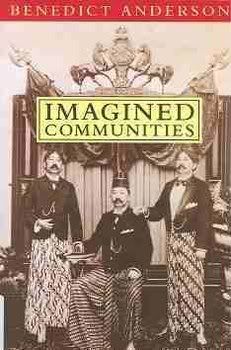
Just finished reading Benedict Anderson
’s impressive study of nationalism. A lot of critical distance in his book. A study thoroughly conducted from astonishing heights of intelligence. A truly impressive piece of scholarly research.An expert on Southeast Asia, Anderson refutes the hypothesis of a purely European origin of nationalism. According to him, “nation-ness [nation, nationality, nationalism] is the most universally legitimate value in the political life of our time”. It is the result of the destruction of the old communities by the new conceptions of space and time that appeared during the era that Hungarian political economist Karl Polanyi called the “Great Transformation”, from the late 18th century. From the ashes of the old world-system, the nation was born, i.e an “imagined political community - and imagined as both inherently limited and sovereign”. The emergence of capitalism, the spread of printing, colonialism and the new states of the Third World provide many elements of explanation and reflection, whose role is insightfully analyzed in this brilliant, erudite, sometimes ironic, comparative study, which reads from cover to cover with an irresistible feeling of intellectual pleasure.
Have yet to finish Race, Nation, Classe by E. Balibar et Wallerstein.
First poem of the cycle almost finished.
Sunday, November 19, 2006
Why economists love empires: from 'The Economist' print edition
"Why economists love empires
 | |
In a speech last year at Oxford University, Manmohan Singh, India's prime minister, caused a stir in his homeland by noting a few "beneficial consequences" of India's years under British rule, including its free press, its civil service and its "notion" of the rule of law. But he also pointed out that India, one of the world's biggest economies in 1700, was impoverished by the time the British left.
However mixed empire's legacy in India, imperialism has recently provided a rich feast for economists. Their interest lies not just in totting up the balance sheet of colonial rule—although that can be fascinating. They are after even bigger game: an explanation of why some countries grow rich and others do not. Of the many proposed solutions to that riddle (technology, geography, the Protestant ethic) the current favourite is rather bland in the abstract: "institutions". In rich economies institutions—meaning the formal laws and unwritten rules that govern society—function rather well on the whole. In poor ones they don't. That much is indisputable.
What is tricky is showing that good institutions are a cause of economic progress rather than a by-product of it. You cannot run controlled experiments in which a particular institution is randomly imposed on some countries, but not on others, in order to compare how they fare. Or at least economists can't. But perhaps imperialists can. Maybe the colonial adventures of the past provide the natural experiments economists need to put their theories to the test.
The imperial powers certainly generated a lot of institutional variety, sprinkling Spanish vassalage, British indirect rule and American paternalism across the globe. But was this variation random? Surely not. Imperialists vied to plant their flag in the most lucrative spots, wherever the spices were rich or the sugar cane tall. Thus a conundrum remains: if, say, America's former colonies have prospered compared with Spain's, was this because America bequeathed the best institutions, or because it found the most promising areas of the world to colonise?
What is ingenious about the recent economic studies of empire is how they overcome this problem. Imperial institutions may determine prosperity, but the reverse may also be true. The trick is to find some third factor that is securely linked to institutions, but entirely unconnected to economic success. Such factors are called "instrumental variables", because the economist is interested in them not for themselves, but for what they tell him about something else.
That name, however, now seems quite ironic. Because all of the fun in the recent spate of papers is in the instruments themselves. Economists are outdoing each other with ever more curious instruments, ranging from lethal mosquitoes to heirless maharajahs, or, most recently, wind speeds and sea currents.
Guam, which became a Spanish colony in the 17th century and an American one at the end of the 19th, was discovered in 1521 after winds and swells carried Ferdinand Magellan, the Portuguese-born explorer, to its shores. In a recent study of 80 such islands, all but one of which eventually fell under the imperial yoke, James Feyrer and Bruce Sacerdote of Dartmouth College argue that winds and currents dictated which islands were colonised when. The early colonialists went where their sails took them; only after steamships became the norm in the 19th century could they travel against the wind.
As a result, some islands were colonised early, some late, for reasons that had much to do with meteorology, and rather little to do with any other intrinsic attractions the islands might offer. The two authors show that the accessible islands, which lay on natural sailing routes, have prospered relative to the others. They put this down in part to the longer period these islands spent under colonial rule. A century as a colony is worth a 40% increase in today's GDP, they argue.
But as the authors point out, this striking result disguises a more disturbing fact. On many islands the original population was decimated, or worse, by European contact. After the Spanish colonised Puerto Rico in 1505, the native population fell from 60,000 to 1,500 within 30 years. The island may have since prospered, but the original islanders did not.
The study paints the British as relatively benign rulers compared with the Iberians. But instruments can cut both ways. Lakshmi Iyer of Harvard has used the technique to reveal some unhappy consequences of the Raj that might have made Mr Singh's Oxford audience squirm. The British, she points out, did not wrest direct control of India all at once. From 1848 to 1856, for example, the governor-general pursued a "doctrine of lapse", taking charge of states whenever the native ruler died without an heir. These states, then, came under British rule as a result of patrilineal misfortune, not economic potential. Ms Iyer shows that such areas had fewer schools, clinics and roads as a result of British rule. The effects lingered into the 1980s.
Once just an obscure statistical method, instrumental variables are now popping up all over the place. Daniel Hamermesh, a labour economist at the University of Texas, has joked about the "instrument police", who patrol empirical economics, forever suspicious that causality may run both ways. Indeed, "reverse causality", which was once a frustrating problem, is now seen as a chance to demonstrate ingenuity. Instruments have brought colour to the study of institutions, and sharpened the debate over colonialism, without really resolving it. But whatever the claims of empire, the instrumental variable now enjoys an almost imperial grip on the imagination of economists."
Saturday, November 18, 2006
Personal decadence and its physical consequences
He had narrowly escaped an all-day business seminar at which he had felt immediately, irremediably out of place. He wished he had slept instead. She had dragged him there of course.
After a brief chat with M. Choi (whom he could hardly remember), he was feeling somewhat relieved that this nuisance of a man was moving to DC the following week. Sitting next to him: J. Yung. He had seen her before. She looked familiar. And certainly very hot as well (perhaps that's why she looked familiar). She reminded him of Hsu Chi. Must have been her lips.
He thought about the night before:
“Yesterday, dinner with R. and S. L. at an upper west side restaurant. OK food. Was recovering from Thursday night, as I still am, today.” (banality of the notation, he thought right away)
Thursday had been quite a decadent night, now that he was thinking about it. He had half expected this to happen when K. called, out of the blue. He was always pleasantly surprised at the odd regularity of their “relationship”. They seemed to maintain a continuous erotic distance.
Not on that night though. That night was sensibly different. He had spent a good amount of time with his hand down her pants. Then got into a weird (but enviable) “ryo te hana” situation (with H.), to use an exaggerated expression. He was surprised he still knew some Japanese. He had downed a few shots with her. Couldn’t quite remember her name. Came back home around 5 AM. Drunk and sick. Predictably. Predictable.
It was good to see Daisuke though. The name of the manager escaped him. Too bad. He was a nice guy as well.
Been having a major pain in the neck, quite literally, since then. Physical aftermath of this minor moral fall.
Subscribe to:
Comments (Atom)